Arithmetic How to Find All Factors of a Number Step by Step
Discover how to find all factors of any whole number using division factor pairs and divisibility shortcuts with step by step examples and factor tables.
Find all factors, factor pairs, visual diagrams, and prime factorizations of any number instantly.
A factor calculator is a mathematical tool that finds every integer which divides evenly into a given number with zero remainder. Enter any positive whole number, and the calculator returns a complete list of its factors, factor pairs, and prime factorization in seconds.
To find the factors of any number, follow these 3 steps. The factor calculator accepts any positive integer from 1 to 10,000,000,000 and returns results instantly.
Type any positive whole number into the input field. The calculator accepts integers from 1 to 10 billion. Decimal values and negative numbers are not valid inputs for integer factorization.
Press the calculate button or hit the Enter key on your keyboard. The factorization algorithm runs a trial division loop up to the square root of your number (√n) and collects all divisors.
The output display shows 4 result sections: a sorted list of all factors, factor pairs that multiply to the original number, an interactive factor pair diagram, and the prime factorization with exponent notation.
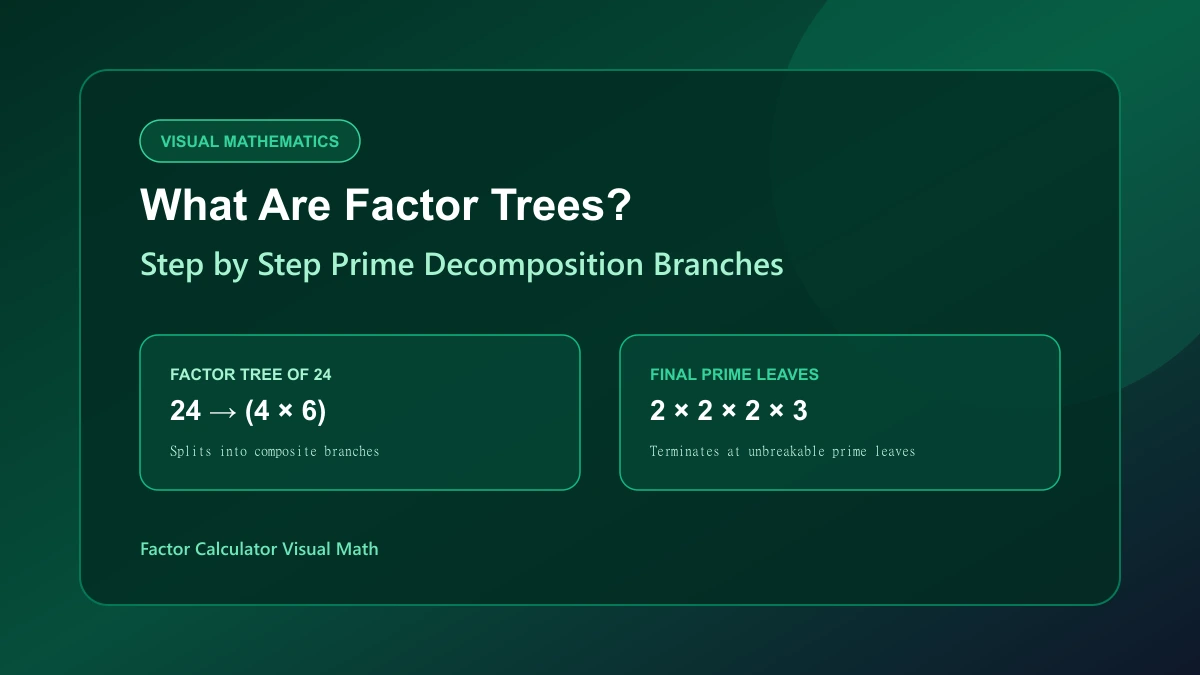
These 4 worked examples show the step-by-step factorization process for common numbers. Each example includes a trial division walkthrough and an interactive factor tree diagram. The factor tree breaks a composite number into prime factors by repeatedly splitting it into two divisors until only prime numbers remain.
6 factors · 3 pairs
Start with 12. Check division by 1: 12 ÷ 1 = 12 (remainder 0). Record factors 1 and 12.
Check division by 2: 12 ÷ 2 = 6 (remainder 0). Record factors 2 and 6.
Check division by 3: 12 ÷ 3 = 4 (remainder 0). Record factors 3 and 4.
Stop at √12 ≈ 3.46. All 6 factors found: 1, 2, 3, 4, 6, 12.
All Factors:
Prime Factorization: 12 = 2² × 3
9 factors · 5 pairs
Start with 36. Check 1: 36 ÷ 1 = 36 (remainder 0). Record factors 1 and 36.
Check 2: 36 ÷ 2 = 18 (remainder 0). Record 2 and 18.
Check 3: 36 ÷ 3 = 12 (remainder 0). Record 3 and 12.
Check 4: 36 ÷ 4 = 9 (remainder 0). Record 4 and 9.
Check 5: 36 ÷ 5 = 7.2 (not a factor). Skip.
Check 6: 36 ÷ 6 = 6 (remainder 0). Record 6 (perfect square pair). Stop at √36 = 6. All 9 factors found.
All Factors:
Prime Factorization: 36 = 2² × 3²
12 factors · 6 pairs
Start with 60. Check 1: 60 ÷ 1 = 60 (remainder 0). Record 1 and 60.
Check 2: 60 ÷ 2 = 30. Record 2 and 30.
Check 3: 60 ÷ 3 = 20. Record 3 and 20.
Check 4: 60 ÷ 4 = 15. Record 4 and 15.
Check 5: 60 ÷ 5 = 12. Record 5 and 12.
Check 6: 60 ÷ 6 = 10. Record 6 and 10.
Check 7: 60 ÷ 7 = 8.57 (not a factor). Stop at √60 ≈ 7.74. All 12 factors found.
All Factors:
Prime Factorization: 60 = 2² × 3 × 5
9 factors · 5 pairs
Start with 100. Check 1: 100 ÷ 1 = 100. Record 1 and 100.
Check 2: 100 ÷ 2 = 50. Record 2 and 50.
Check 3: 100 ÷ 3 = 33.33 (not a factor). Skip.
Check 4: 100 ÷ 4 = 25. Record 4 and 25.
Check 5: 100 ÷ 5 = 20. Record 5 and 20.
Check 6–9: none divide evenly.
Check 10: 100 ÷ 10 = 10 (perfect square pair). Stop at √100 = 10. All 9 factors found.
All Factors:
Prime Factorization: 100 = 2² × 5²
There are 5 main types of factor calculations used in mathematics, from basic integer factorization to polynomial decomposition in algebra. Each type serves a different purpose in number theory, arithmetic, and equation solving.
Integer factorization finds all positive whole numbers that divide evenly into a target number. The result is a finite set of divisors. The number 48 has 10 factors: 1, 2, 3, 4, 6, 8, 12, 16, 24, 48.
Prime factorization (also called prime decomposition) breaks a composite number into a product of prime numbers. The Fundamental Theorem of Arithmetic guarantees this decomposition is unique for every integer greater than 1. For example, 72 = 2³ × 3².
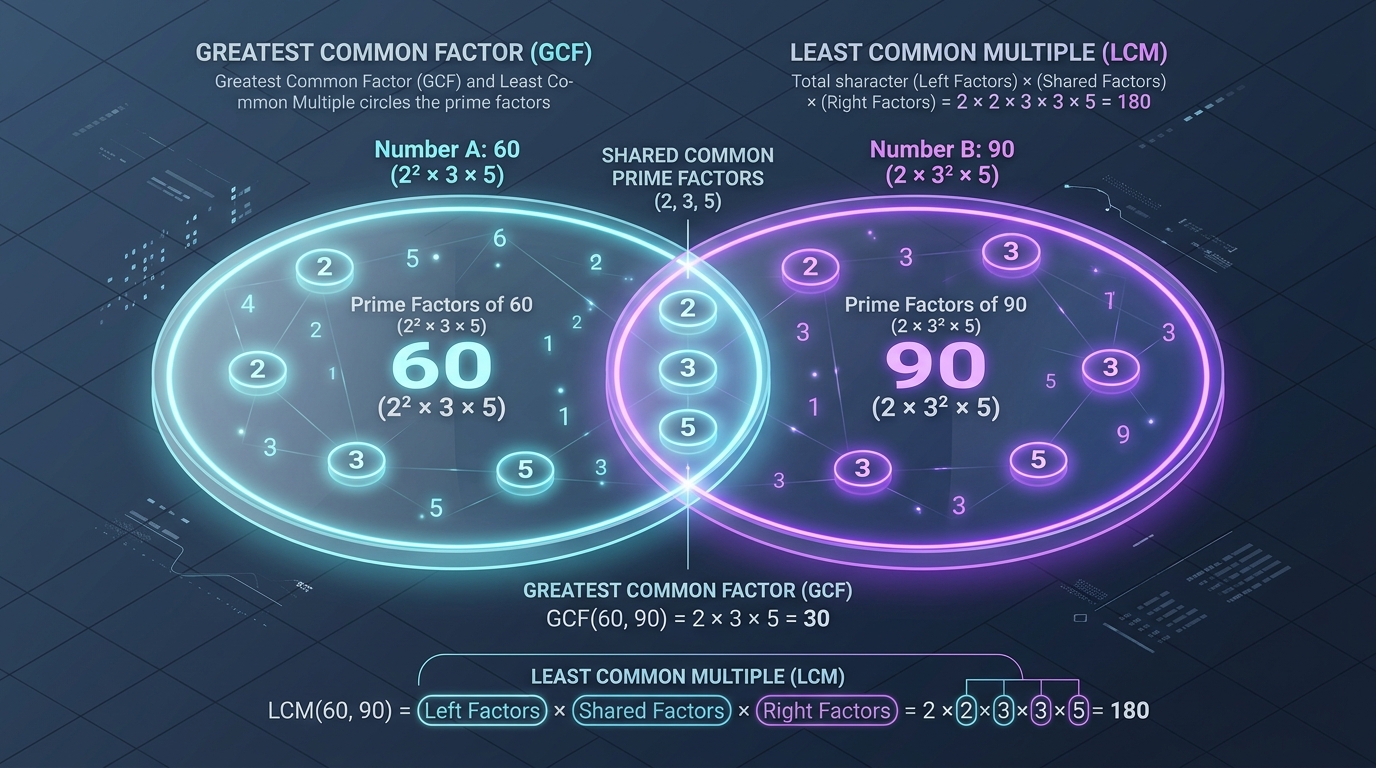
The Greatest Common Factor (GCF), also called the Greatest Common Divisor (GCD), is the largest number that divides two or more integers without a remainder. The GCF of 36 and 48 is 12. GCF calculations simplify fractions: 36/48 reduces to 3/4 after dividing both by the GCF.
The Least Common Multiple (LCM) is the smallest positive integer divisible by two or more numbers. The LCM of 12 and 18 is 36. LCM is used when adding or subtracting fractions with different denominators — it identifies the common denominator.
The factor calculator uses a trial division algorithm that tests every integer from 1 up to the square root of the input number (√n). This approach runs in O(√n) time — for a number like 1,000,000, the algorithm checks only 1,000 divisors instead of all 1,000,000 candidates.
Input: Number n
Valid Integer?
Set i = 1, factors = [ ]
i × i ≤ n ?
n mod i == 0 ?
If yes: add i and n/i to factors
i = i + 1, loop back ↑
Output: Sorted Factors
+ pairs, diagram, prime decomposition
This reference table lists the factors of 41 commonly searched numbers, from 1 to 1,000. Click any row to expand factor pairs and prime factorization details. Use the search field to filter by number.
| Number | Type | Factors | Count | Prime Form |
|---|---|---|---|---|
| 1 | Neither | 1 | 1 | — |
| 2 | Prime | 1, 2 | 2 | 2 |
| 3 | Prime | 1, 3 | 2 | 3 |
| 4 | Composite | 1, 2, 4 | 3 | 2² |
| 5 | Prime | 1, 5 | 2 | 5 |
| 6 | Composite | 1, 2, 3, 6 | 4 | 2 × 3 |
| 7 | Prime | 1, 7 | 2 | 7 |
| 8 | Composite | 1, 2, 4, 8 | 4 | 2³ |
| 9 | Composite | 1, 3, 9 | 3 | 3² |
| 10 | Composite | 1, 2, 5, 10 | 4 | 2 × 5 |
| 12 | Composite | 1, 2, 3, 4, 6, 12 | 6 | 2² × 3 |
| 15 | Composite | 1, 3, 5, 15 | 4 | 3 × 5 |
| 16 | Composite | 1, 2, 4, 8, 16 | 5 | 2⁴ |
| 18 | Composite | 1, 2, 3, 6, 9, 18 | 6 | 2 × 3² |
| 20 | Composite | 1, 2, 4, 5, 10, 20 | 6 | 2² × 5 |
| 24 | Composite | 1, 2, 3, 4, 6, 8, 12, 24 | 8 | 2³ × 3 |
| 25 | Composite | 1, 5, 25 | 3 | 5² |
| 28 | Composite | 1, 2, 4, 7, 14, 28 | 6 | 2² × 7 |
| 30 | Composite | 1, 2, 3, 5, 6, 10, 15, 30 | 8 | 2 × 3 × 5 |
| 32 | Composite | 1, 2, 4, 8, 16, 32 | 6 | 2⁵ |
| 36 | Composite | 1, 2, 3, 4, 6, 9, 12, 18, 36 | 9 | 2² × 3² |
| 40 | Composite | 1, 2, 4, 5, 8, 10, 20, 40 | 8 | 2³ × 5 |
| 42 | Composite | 1, 2, 3, 6, 7, 14, 21, 42 | 8 | 2 × 3 × 7 |
| 48 | Composite | 1, 2, 3, 4, 6, 8, 12, 16, 24, 48 | 10 | 2⁴ × 3 |
| 50 | Composite | 1, 2, 5, 10, 25, 50 | 6 | 2 × 5² |
| 56 | Composite | 1, 2, 4, 7, 8, 14, 28, 56 | 8 | 2³ × 7 |
| 60 | Composite | 1, 2, 3, 4, 5, 6, 10, 12, 15, 20, 30, 60 | 12 | 2² × 3 × 5 |
| 64 | Composite | 1, 2, 4, 8, 16, 32, 64 | 7 | 2⁶ |
| 72 | Composite | 1, 2, 3, 4, 6, 8, 9, 12, 18, 24, 36, 72 | 12 | 2³ × 3² |
| 80 | Composite | 1, 2, 4, 5, 8, 10, 16, 20, 40, 80 | 10 | 2⁴ × 5 |
| 84 | Composite | 1, 2, 3, 4, 6, 7, 12, 14, 21, 28, 42, 84 | 12 | 2² × 3 × 7 |
| 90 | Composite | 1, 2, 3, 5, 6, 9, 10, 15, 18, 30, 45, 90 | 12 | 2 × 3² × 5 |
| 96 | Composite | 1, 2, 3, 4, 6, 8, 12, 16, 24, 32, 48, 96 | 12 | 2⁵ × 3 |
| 100 | Composite | 1, 2, 4, 5, 10, 20, 25, 50, 100 | 9 | 2² × 5² |
| 120 | Composite | 1, 2, 3, 4, 5, 6, 8, 10, 12, 15, 20, 24, 30, 40, 60, 120 | 16 | 2³ × 3 × 5 |
| 144 | Composite | 1, 2, 3, 4, 6, 8, 9, 12, 16, 18, 24, 36, 48, 72, 144 | 15 | 2⁴ × 3² |
| 180 | Composite | 1, 2, 3, 4, 5, 6, 9, 10, 12, 15, 18, 20, 30, 36, 45, 60, 90, 180 | 18 | 2² × 3² × 5 |
| 200 | Composite | 1, 2, 4, 5, 8, 10, 20, 25, 40, 50, 100, 200 | 12 | 2³ × 5² |
| 360 | Composite | 1, 2, 3, 4, 5, 6, 8, 9, 10, 12, 15, 18, 20, 24, 30, 36, 40, 45, 60, 72, 90, 120, 180, 360 | 24 | 2³ × 3² × 5 |
| 500 | Composite | 1, 2, 4, 5, 10, 20, 25, 50, 100, 125, 250, 500 | 12 | 2² × 5³ |
| 1000 | Composite | 1, 2, 4, 5, 8, 10, 20, 25, 40, 50, 100, 125, 200, 250, 500, 1000 | 16 | 2³ × 5³ |
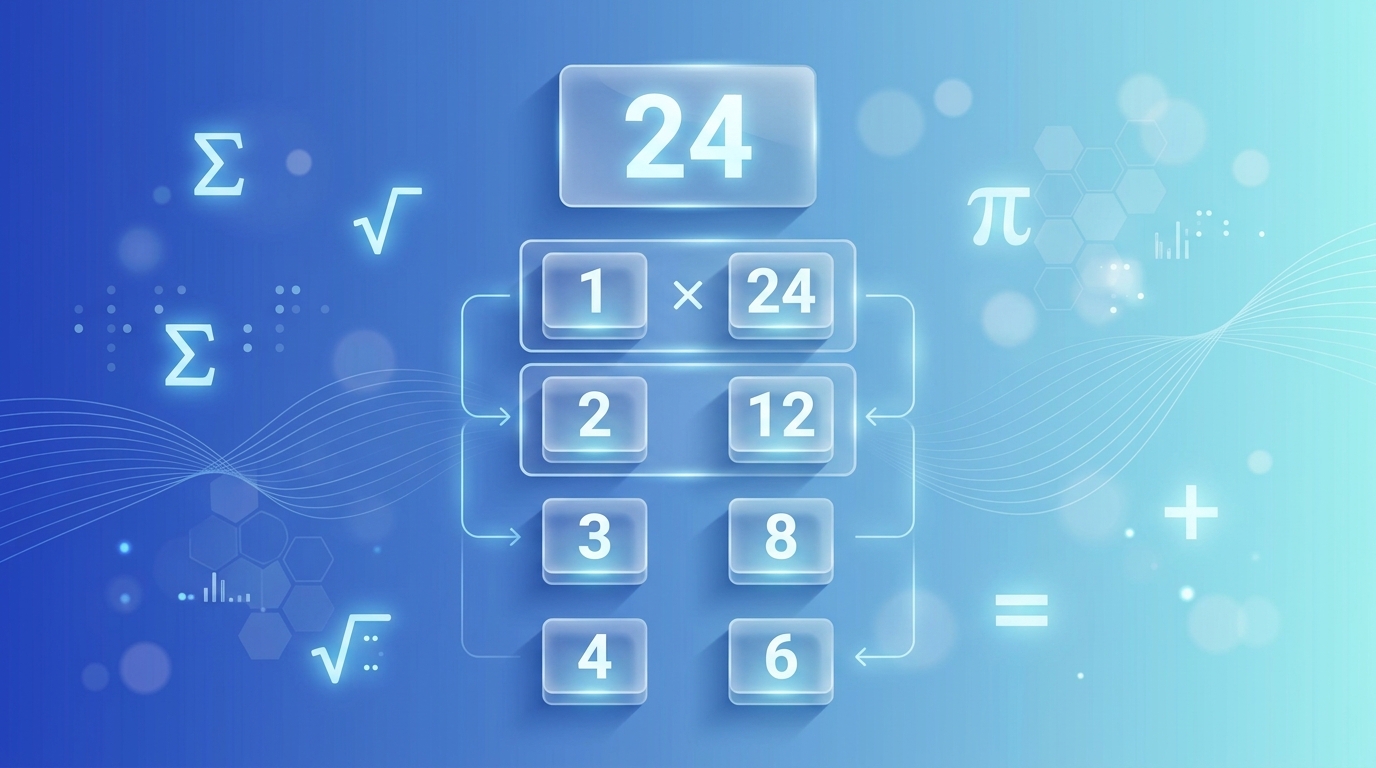
This table covers frequently referenced numbers in mathematics homework, GCF and LCM problems, and number theory exercises. Use the factor calculator above for any number up to 10 billion (10,000,000,000).
13 specialized math calculators — from polynomial factoring to percentage conversion.
Find quick answers to common questions regarding factors, prime decompositions, and calculation methods.
Divide the number by every integer from 1 up to its square root — each zero-remainder division gives you a factor pair.
The factors of 12 are 1, 2, 3, 4, 6, and 12, with factor pairs (1×12), (2×6), (3×4) and prime factorization 2² × 3.
Factors divide evenly into a number and form a finite set, while multiples are produced by multiplying the number by 1, 2, 3… and form an infinite sequence.
Yes — enter any integer ≥ 2 and the calculator returns its unique prime decomposition in both expanded and exponent notation.
A fitment factor calculator is an automotive tool for checking wheel and tire compatibility — it is unrelated to mathematical factorization.
A power factor calculator measures the ratio of real power to apparent power in an AC circuit — it is an electrical engineering tool, not a math factorization tool.
Explore popular tutorials and practical guides to master factorizations, divisibility, and number theory.
Arithmetic Discover how to find all factors of any whole number using division factor pairs and divisibility shortcuts with step by step examples and factor tables.
Arithmetic Master simple methods for finding greatest common factor and least common multiple using factor lists prime factorization and relationship formulas.
Visual Math Learn how factor trees work to find prime factorizations step by step with visual branching diagrams starting pairs and verification methods.