
Numbers hide little secrets inside them. Every whole number breaks down into smaller pieces called factors, and once you know how to find factors, math starts to feel less like guesswork. This guide walks you through find all factors of a number using simple steps, real examples, and easy tricks anyone can use.
What Is a Factor and How Does Factor Pairing Work?
A factor of a number is any whole number that divides it evenly, leaving no remainder behind. Think of whole number factors as building blocks. Multiply two of them together and you rebuild the original number. This is where factor pairs explained comes in handy, since every factor has a partner.
Factor pairs work through simple multiplication. For factors of 12, you get 1×12, 2×6, and 3×4. Each pair shows multiplication factors at work. Learning how do factors work early makes later math, like fractions and ratios, much smoother down the road.
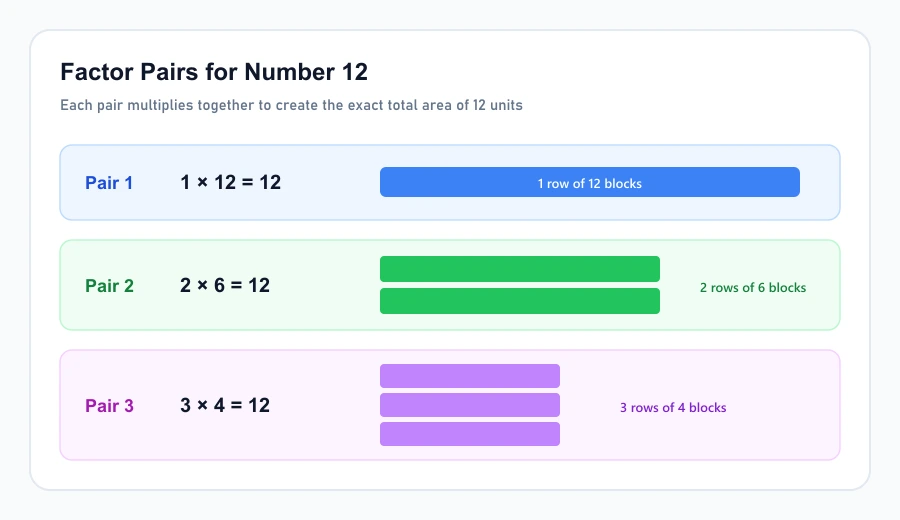
Visual diagram illustrating factor pairs and multiplication blocks for twelve
How to Find Factors Using Division
Finding factors by division is the most reliable method around. Start at 1 and divide your number step by step. If the answer comes out clean, you found a factor. This factor calculation process never fails when done carefully and slowly.
Try it with factors of 24. Divide by 1, 2, 3, 4, 6, 8, 12, and 24. Each division works perfectly. This is the easiest way to find factors, and it forms the base of every factor worksheet students see in school. Practice makes the factor test feel effortless.
How to List Factor Pairs From Smallest to Largest
How to list factors properly means staying organized. Always start small and work upward. This factor pair method keeps your list neat and stops you from missing anything important along the way.
| Number | Factor Pairs |
|---|---|
| Factors of 36 | 1×36, 2×18, 3×12, 4×9, 6×6 |
| Factors of 48 | 1×48, 2×24, 3×16, 4×12, 6×8 |
| Factors of 60 | 1×60, 2×30, 3×20, 4×15, 5×12, 6×10 |
This factor chart style, or factor table method, gives you a complete factor list at a glance and works for any number factors problem you face.
How to Find Factors of Prime and Composite Numbers
A prime number only has two factors: itself and 1. A composite number has more than two, making it richer in composite factors. Knowing this difference speeds up every factor identification task you tackle.
Factors of prime numbers are short and simple, like 7 with only 1 and 7. Factors of composite numbers, such as factors of 100, stretch longer: 1, 2, 4, 5, 10, 20, 25, 50, 100. This split matters for prime factors work and later for building a factor tree.
How to Check Whether a Number Is a Factor
Checking factors gets faster once you learn divisibility rules. These shortcuts skip long division entirely. A number is divisible by 2 if it ends in an even digit. It’s divisible by 5 if it ends in 0 or 5.
Divisibility tests save real time on big homework sets. For factors of 72, checking divisibility by 2, 3, 4, 6, 8, and 9 confirms each one quickly. This division test approach is a favorite in every math factors lesson for good reason.
How to Find Factors Without Missing Any Pairs
Missing a pair is the most common slip up in number factorization. The fix is simple: check every number in order, without skipping any along the way. This keeps your factor sequence complete and accurate.
A steady factor pattern helps too. As one factor grows, its partner shrinks, meeting somewhere in the middle. For factors of 144, this pattern runs from 1 all the way to 12, where the pair meets itself. Following this factor relationship avoids gaps entirely.
How Factors Help With Multiplication and Divisibility
Factors of integers connect directly to real math skills, like simplifying fractions. The common factor shared between two numbers shrinks a fraction down to its simplest form, fast and cleanly every time.
This also builds toward the greatest factor, often called the greatest common factor, used in reducing fractions. Divisor pairs and integer divisors both lean on this same logic, tying multiplication pairs directly to everyday division problems students solve.
How to Find Factors of Large Numbers Efficiently
Big numbers don’t need extra effort with the right shortcut. You only need to check up to the square root of the number. Past that point, factor pairs simply repeat themselves in reverse order.
For factors of 200, the square root sits near 14, so checking up to 14 finds everything. The same trick applies to factors of 250, factors of 500, and factors of 1000. This factor calculation steps shortcut is a lifesaver for a factors calculator or manual work alike.
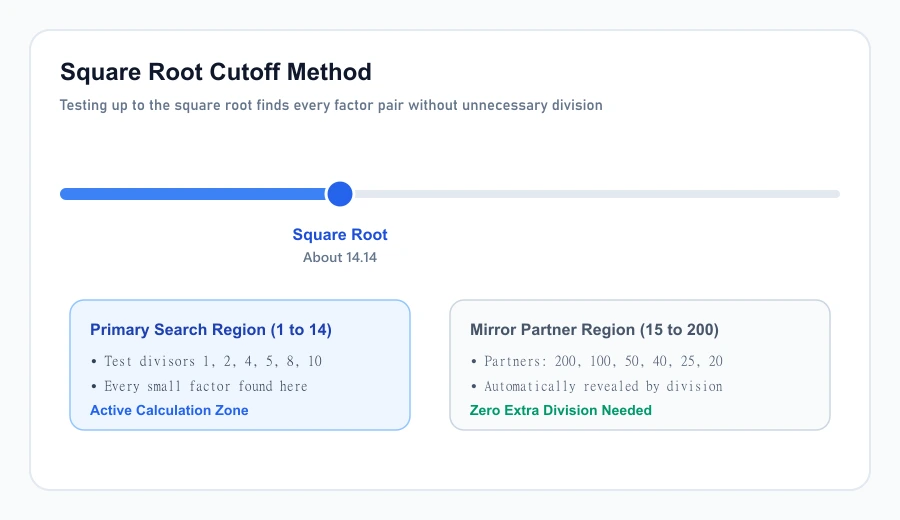
Chart explaining how checking divisors up to the square root finds all factor pairs
What Common Mistakes Should You Avoid When Finding Factors?
Students often forget 1 and the number itself, both valid positive factors every single time. Another slip is confusing factors with multiples, which is a completely different idea. Factor problem solving demands careful attention to detail.
Skipping negative factors is another gap, since negative 1, negative 2, and similar numbers technically count too in advanced math. A factor finder or factor pairs calculator helps double check your work. Practicing factor exercises regularly builds real confidence over time.
Conclusion
Learning how to find factors doesn’t need to feel hard. With steady division, smart divisibility rules, and a clear factor pair method, any elementary factorization or middle school factors problem becomes simple. Keep practicing factor questions, use a factor list calculator when stuck, and soon factoring numbers will feel completely natural.