
Breaking numbers apart visually makes prime factorization click faster. A factor tree shows exactly how a number splits into its building blocks. Here’s how factor trees work, step by step.
What Is a Factor Tree?
A factor tree is a diagram showing how a number breaks down into factor pairs, repeatedly, until only prime numbers remain. Branches spread outward, ending in unbreakable prime leaves.
This factor tree method turns abstract prime factorization into a visual, satisfying process. Beginners often find factor trees explained this way far easier than pure symbolic number factorization work.
How to Start a Factor Tree With a Composite Number
Begin with any composite number at the top. Split it into any two factor pairs that multiply back to the original. This first split kicks off the entire factor tree structure.
For 24, start by splitting into 4 and 6. This is how to make a factor tree: pick any valid pair, since different starting factor branches always end at the same final result.
How to Keep Splitting Factors Until Only Primes Remain
Continue splitting factors at each branch. If a number is composite, split it again. If it’s already prime, stop that branch immediately, since it cannot break down further.
For the factor tree of 24: 4 splits into 2 and 2, while 6 splits into 2 and 3. All four end branches are now prime numbers, so the splitting stops.
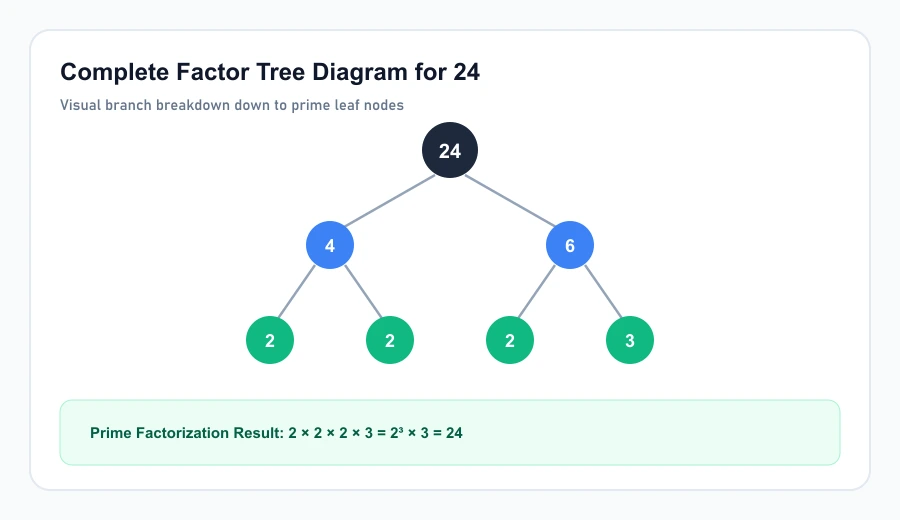
Step by step factor tree branching diagram splitting twenty four down into prime numbers
How Factor Trees Reveal Prime Factorization
Once every branch ends in a prime leaf, collect them all together. Multiplying these primes reconstructs the original number, confirming complete prime decomposition through the finished factor tree diagram.
For 24, the primes collected are 2, 2, 2, and 3. Multiplying gives 2×2×2×3 = 24, confirming accurate prime factors using factor tree results.
How to Build a Factor Tree With Different Factor Pairs
Starting with a different factor pair always reaches the same final primes. Try splitting 24 into 2 and 12 instead of 4 and 6, then continue splitting from there.
| Starting Pair | Final Primes |
|---|---|
| 4 × 6 | 2, 2, 2, 3 |
| 2 × 12 | 2, 2, 2, 3 |
Both paths confirm the same prime factorization, showing factor tree examples always converge.
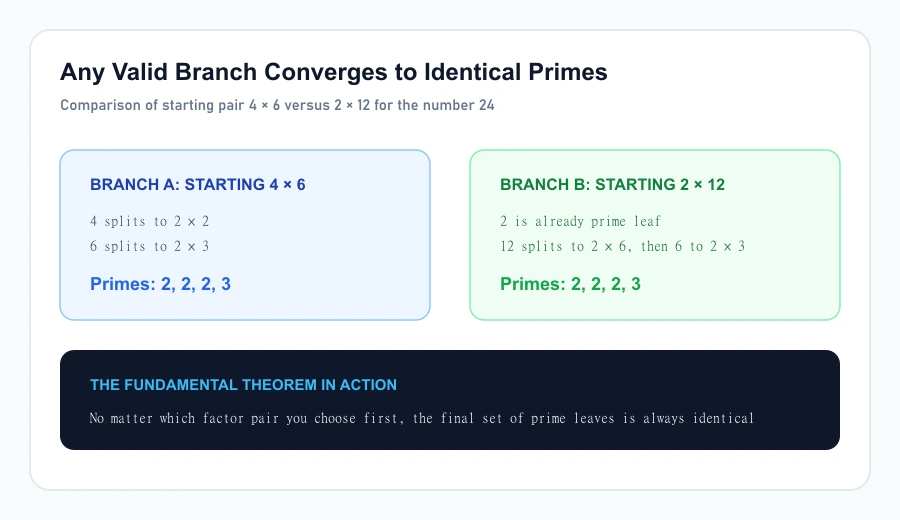
Comparative factor tree diagram showing two different starting branches reaching identical prime leaves
How to Check a Factor Tree for Accuracy
Factor tree verification simply means multiplying all your final prime leaves back together. If the result matches your starting number, the tree is correct and complete.
This prime factor check step catches mistakes early. Skipping this check a factor tree habit risks carrying an error forward into GCF, LCM, or other later factor tree math work.
How Factor Trees Compare With Repeated Division
Factor tree versus division methods reach identical results through different visuals. Repeated division divides by primes step by step in a column, while trees branch outward visually instead.
Some students prefer repeated factorization through division for its tidiness. Others prefer the factor tree diagram for its visual clarity. Both remain valid, interchangeable prime factorization strategies.
How Factor Trees Help With GCF, LCM, and Simplifying Fractions
Once you have prime factors from a factor tree, finding GCF and LCM becomes simple comparison work. Shared primes build the GCF; combined primes build the LCM quickly.
This connects directly back to earlier GCF and LCM lessons. A completed factor tree essentially hands you every ingredient needed for fraction GCF or LCM word problems instantly.
How to Build Factor Trees for Large Composite Numbers
For large composite numbers, start by dividing out small primes like 2, 3, or 5 first. This keeps branches manageable and prevents the factor tree diagram from becoming overwhelming.
Building a factor tree for large composite numbers patiently, one small prime at a time, keeps the process organized. This factor tree algorithm scales reliably to fairly large starting values.
Conclusion: How Factor Trees Make Prime Factorization Easier
Factor trees turn abstract prime factorization into a clear, visual process. From simple factor tree examples to large composite numbers, this factor tree method remains one of math’s most approachable learning tools.