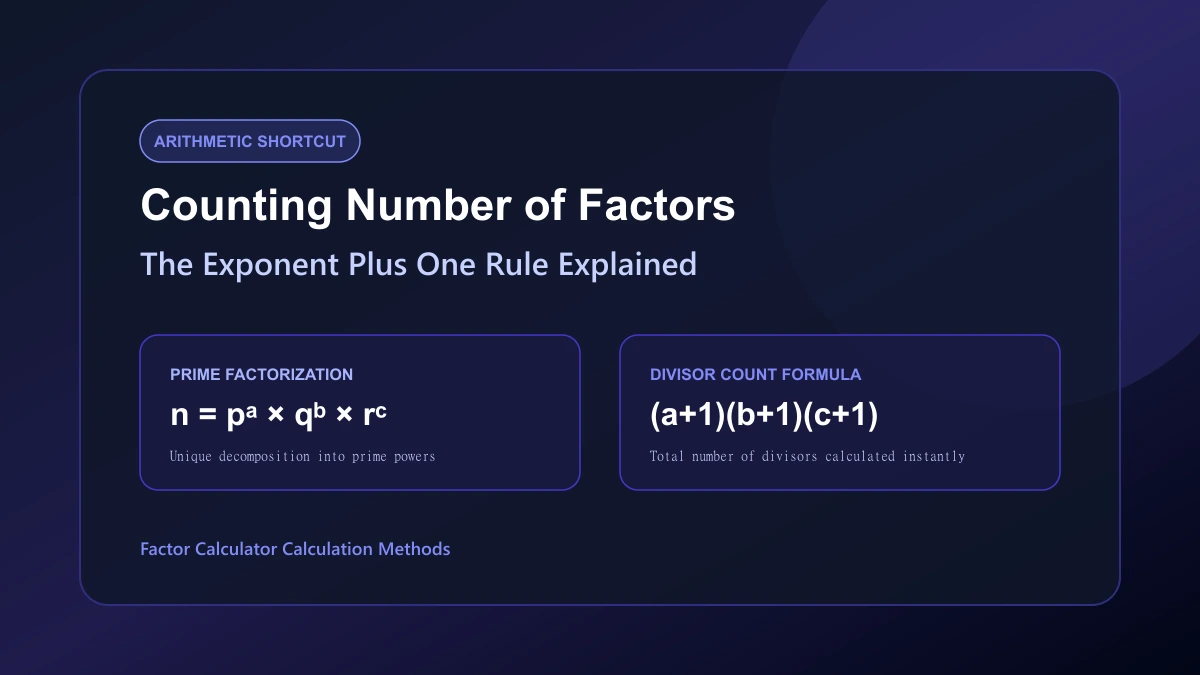
Counting every factor by hand wastes time on big numbers. Luckily, the number of factors can be calculated instantly using prime factorization. This guide shows how to count factors the smart way.
What Does the Number of Factors Mean?
Number of factors, also called divisor count or factor count, simply means how many positive divisors a number has total. This value matters in fraction work, scheduling, and advanced number theory.
Instead of listing every factor manually, mathematicians use a divisor function, sometimes labeled the tau function. This shortcut delivers the exact factor count without ever writing out a full list.
How Prime Exponents Determine the Factor Count
Prime exponents hold the secret. Break a number into prime factorization form, note each exponent, add one to every exponent, then multiply those results together for the total divisor count.
This exponent plus one rule works every single time. Understanding how exponents determine factors turns a tedious counting task into a fast, reliable factor counting method anyone can use.
How to Use the Divisor Counting Formula
The number of divisors formula looks like this: if n = p^a × q^b, then factor count equals (a+1)(b+1). This divisor counting formula scales easily to numbers with more prime factors.
For 12 = 2² × 3¹, the formula gives (2+1)(1+1) = 6. Checking manually confirms 12 has exactly six factors: 1, 2, 3, 4, 6, 12.
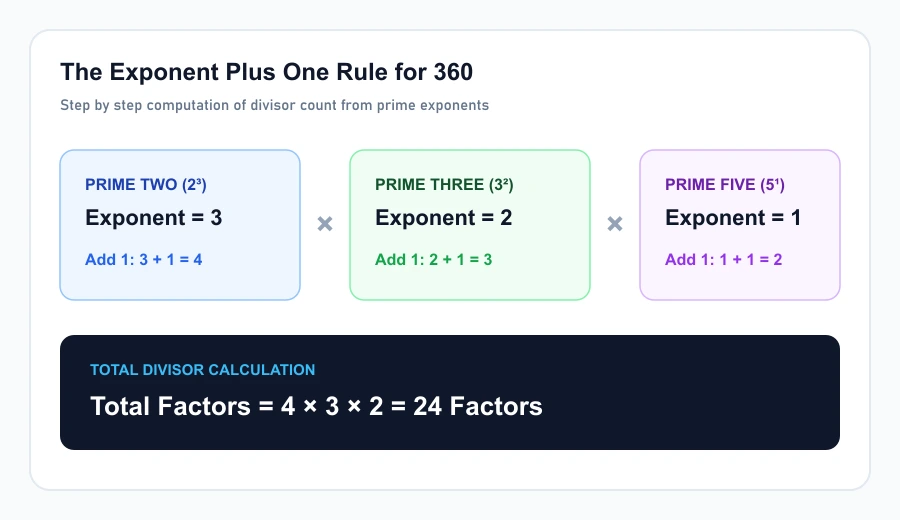
Diagram explaining the exponent plus one formula for calculating total factor counts
How to Count Factors of a Prime Number
A prime number always has exactly two factors: 1 and itself. Its prime factorization is simply itself to the first power, giving (1+1) = 2 through the factor count rule.
This makes factors of prime numbers the simplest possible case. Every prime power greater than one follows a predictable pattern once you understand this basic divisor formula foundation.
How to Count Factors of a Composite Number
Composite numbers need full prime factorization first. Break the number down completely, apply the exponent plus one rule to each prime, then multiply every result together for the final count.
| Number | Prime Factorization | Factor Count |
|---|---|---|
| 24 | 2³ × 3¹ | (3+1)(1+1) = 8 |
| 36 | 2² × 3² | (2+1)(2+1) = 9 |
| 60 | 2² × 3¹ × 5¹ | (2+1)(1+1)(1+1) = 12 |
How to Calculate the Number of Factors With Examples
Practicing with real factor count examples builds confidence fast. Factors of 100 count equals nine, since 100 = 2² × 5², giving (2+1)(2+1) = 9 through the divisor counting method.
Try factors of 144 count yourself. Since 144 = 2⁴ × 3², the formula gives (4+1)(2+1) = 15. This factor count calculator logic works for any integer.
How Factor Pairs Explain Why the Formula Works
Factor pairs naturally come in twos, since each divisor has a partner. The exponent plus one rule essentially counts how many ways prime powers combine to form each unique divisor pairs count.
This connection between factor pairs and the divisor formula isn’t coincidental; it’s structural. Every pairing reflects a specific combination of the number’s underlying prime factor exponent values.
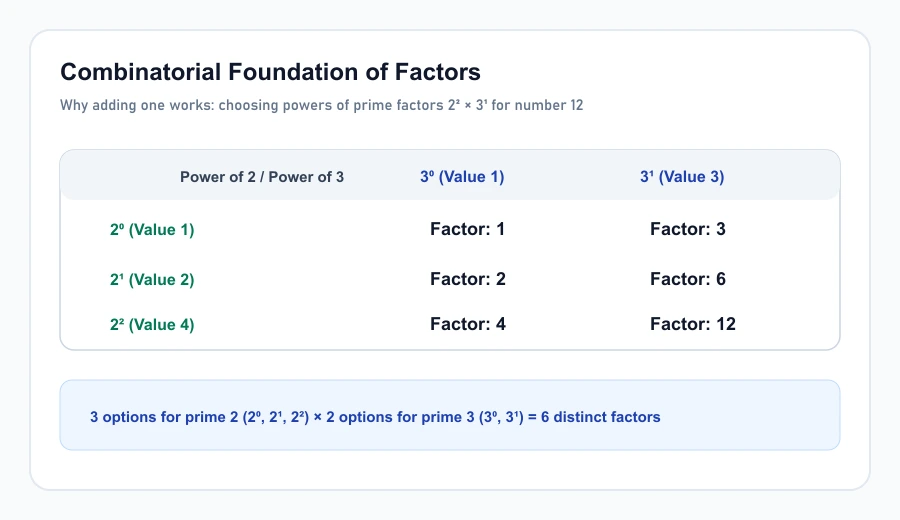
Visual chart showing how combinations of prime powers create each unique divisor
How Perfect Squares Change the Pairing Pattern
Perfect squares create an exception. One factor, the square root, pairs with itself instead of a partner, producing an odd divisor count instead of the usual even divisor count pattern.
This non square divisor count difference is a handy check. If your calculated factor count comes out odd, the original number is almost certainly a perfect square divisor count case.
How to Count Factors of Very Large Numbers Efficiently
For very large numbers, manual factor listing becomes impossible. Relying on the divisor counting formula instead keeps calculations fast, accurate, and manageable even with enormous prime factor exponent combinations.
This efficient factor counting approach is exactly what a divisor function calculator uses internally. Learning the formula yourself means never depending entirely on a factor count calculator again.
Conclusion: How to Find the Number of Factors Quickly
Counting factors doesn’t require listing them all. With prime factorization, the exponent plus one rule, and a little divisor counting practice, finding the number of factors becomes fast, reliable, and genuinely simple.