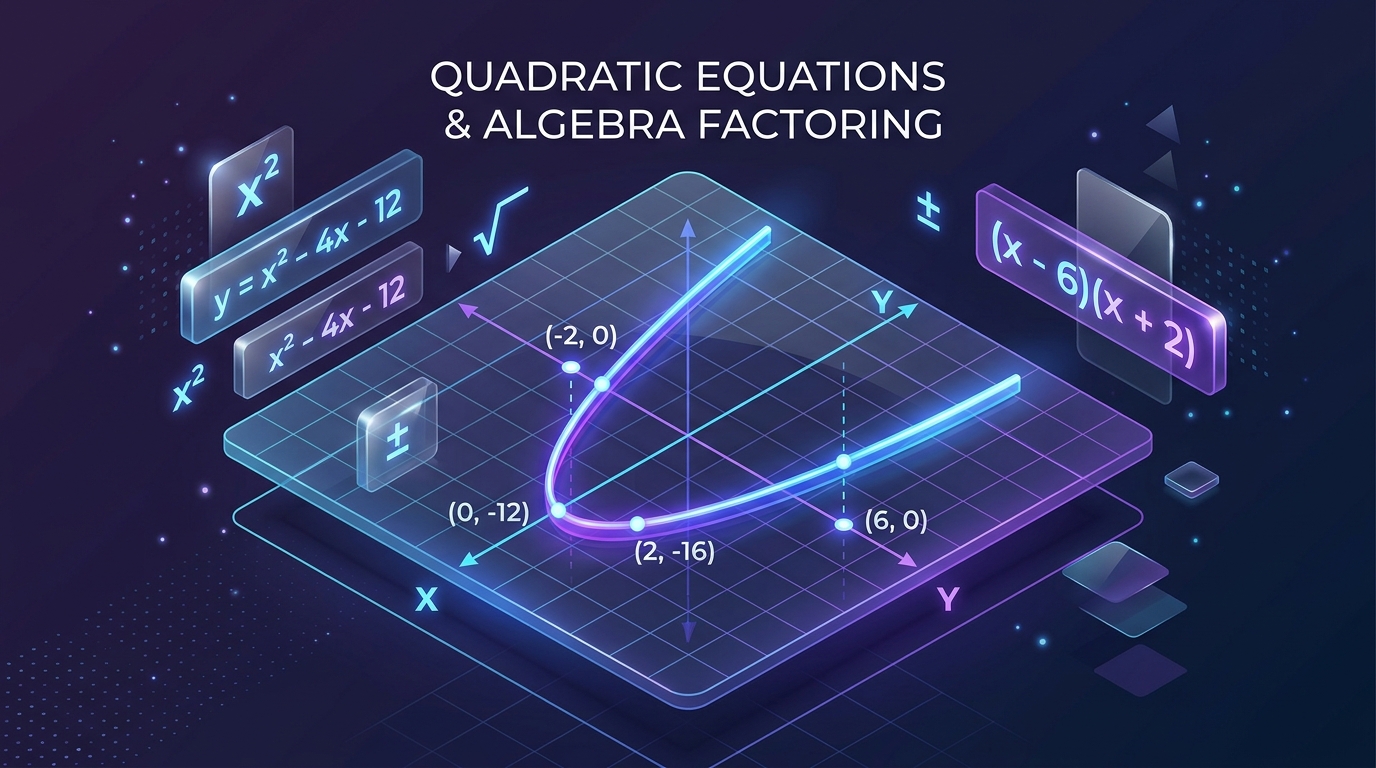
Algebra gets a bad reputation, but quadratic factoring is one skill that actually clicks once you see the pattern. This guide breaks down factoring quadratic equations step by step, using real numbers and clear logic anyone can follow along with easily.
What Is a Quadratic Equation in Factored Form?
A quadratic equation written in factored form looks like two smaller expressions multiplied together. Instead of ax² + bx + c, you get something like (x+2)(x+3). This factored form reveals the equation’s hidden roots instantly.
How to factor a quadratic starts with recognizing this structure. Every trinomial can potentially break into two binomial pieces. Spotting this pattern early makes the entire quadratic factoring process feel far less intimidating for beginners.
How to Identify the Values of a, b, and c
Before factoring trinomials, identify three numbers. The leading coefficient is a, the middle term number is b, and the constant term is c. These three values guide every decision you make next.
Take x² + 5x + 6. Here, a equals 1, b equals 5, and c equals 6. This simple labeling step, part of every quadratic factoring examples walkthrough, sets up the rest of the algebraic factoring work smoothly.
How to Factor Quadratics When the Leading Coefficient Is 1
Factoring when a equals one is the simplest case. Find two numbers that multiply to c and add to b. For x² + 5x + 6, those numbers are 2 and 3, giving (x+2)(x+3).
This method works because factor pairs for quadratics mirror factor pairs in regular numbers. Once you master how to factor trinomials this way, harder problems with bigger coefficients become much easier to handle confidently.
How to Factor Quadratics When the Leading Coefficient Is Greater Than 1
Factoring when a is not one needs extra care. Multiply a and c first, then find factors of that product adding to b. This is the setup behind the AC method for quadratic factoring.
For 2x² + 7x + 3, multiply 2 and 3 to get 6. Two numbers multiplying to 6 and adding to 7 are 6 and 1. This leads into the AC method covered fully next.
How to Use the AC Method for Quadratic Factoring
The AC factoring approach uses grouping method logic. Split the middle term using your two found numbers, then group and factor pairs separately. This product sum method turns messy trinomials into clean binomial pairs.
Using 2x² + 7x + 3, split 7x into 6x + x. Group (2x² + 6x) and (x + 3), factor each part, and combine. This split the middle term trick handles almost any quadratic trinomial.

Step diagram showing how the AC method splits the middle term in quadratic equations
How to Check a Factored Quadratic by Multiplying
Always verify your work using the FOIL factoring check. Multiply your two binomial answers back together and confirm you land on the original quadratic expression. Skipping this step invites careless errors.
| Factored Form | Expanded Check |
|---|---|
| (x+2)(x+3) | x² + 5x + 6 |
| (2x+1)(x+3) | 2x² + 7x + 3 |
This quadratic zero product property check, common in every polynomial factoring lesson, confirms your quadratic solutions are accurate before moving forward.
How to Recognize Quadratics That Cannot Be Factored Over Integers
Some quadratic expressions simply refuse to break into clean integer factors. When no whole numbers multiply and add correctly, the equation is a nonfactorable quadratic over standard integers.
The discriminant, found using b² minus 4ac, reveals this instantly. A negative or non perfect square result signals irrational roots ahead. This distinguishes a factorable quadratic from one needing other quadratic factoring steps.
How Factoring Connects Quadratic Equations to Their Roots
Every quadratic roots value comes directly from its factors. Set each binomial equal to zero and solve. This zero product rule transforms factored form into actual number solutions instantly.
For (x+2)(x+3)=0, the roots are negative 2 and negative 3. This connection between quadratic factoring and find roots by factoring makes factoring genuinely useful, not just a classroom exercise for algebra students.
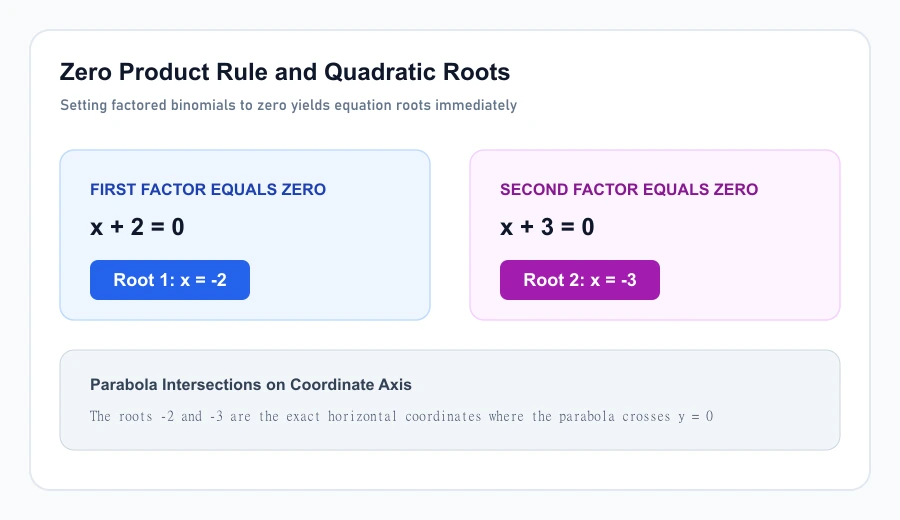
Educational visual explaining how the zero product property reveals quadratic roots
How to Decide Between Factoring, Completing the Square, and the Quadratic Formula
Factoring works best for simple, clean quadratic equation problems. When numbers get messy or the discriminant looks unfriendly, the quadratic formula comparison or completing square comparison methods handle things better.
This easiest quadratic factoring method decision saves time. Most quadratic factoring practice problems in school favor factoring first, since it’s faster than other factorization techniques when the numbers cooperate nicely.
Conclusion: How to Factor Quadratic Equations Step by Step
Mastering quadratic factoring takes practice, patience, and pattern recognition. From spotting common factoring mistakes to using the AC method, each quadratic factoring steps builds real algebra confidence. Keep practicing, and solve quadratics by factoring will soon feel automatic.