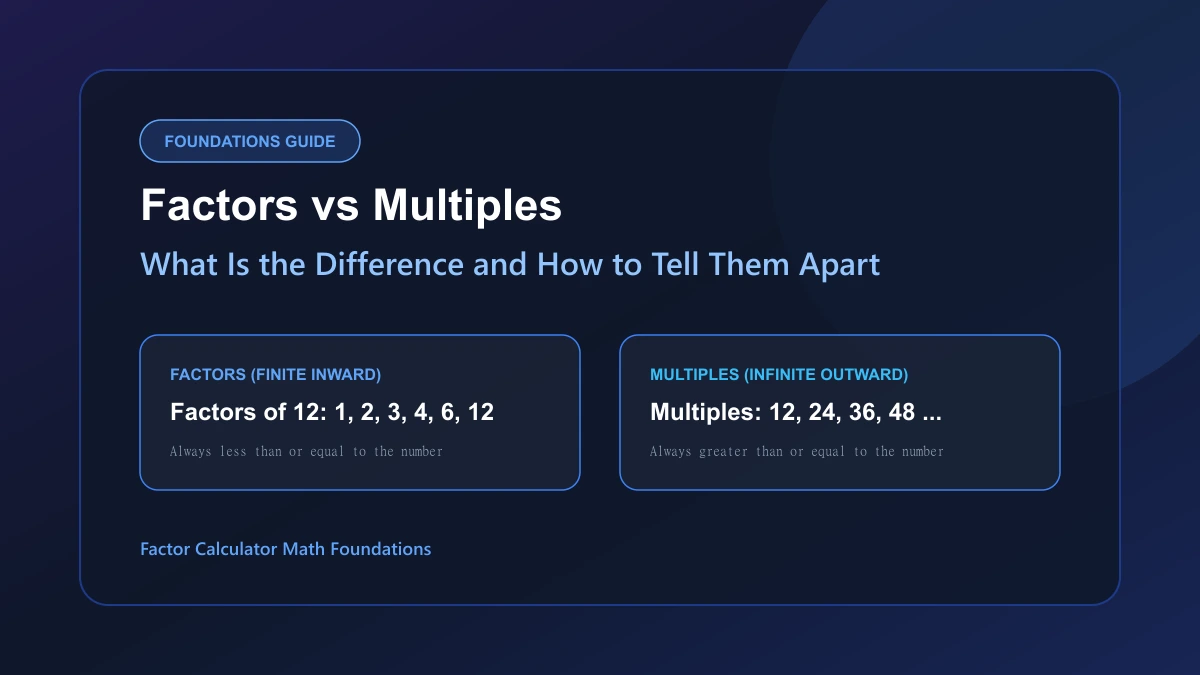
Students often mix up factors and multiples, but the difference is simple once explained clearly. This guide breaks down factors vs multiples difference, using easy examples anyone can follow.
What Is a Factor?
A factor divides a number evenly, producing no remainder. Factors of a number are always smaller than or equal to that number itself. This factor definition anchors the entire comparison ahead.
For example, factors of 12 include 1, 2, 3, 4, 6, and 12. Each divides 12 cleanly, confirming their status as legitimate factors through simple division relationship testing.
What Is a Multiple?
A multiple results from multiplying a number by any whole number. Multiples of a number stretch infinitely upward, unlike factors, which stay limited and finite for any given integer.
Multiples of 12 include 12, 24, 36, 48, and beyond forever. This multiple definition shows the key structural difference separating multiples clearly from the finite factor list concept.
How Factors and Multiples Are Connected
Factors and multiples are opposite sides of multiplication. If 3 is a factor of 12, then 12 is automatically a multiple of 3. This factor multiple relationship flows in both directions.
| Concept | Direction | Example |
|---|---|---|
| Factor | Divides into | 3 is a factor of 12 |
| Multiple | Results from | 12 is a multiple of 3 |
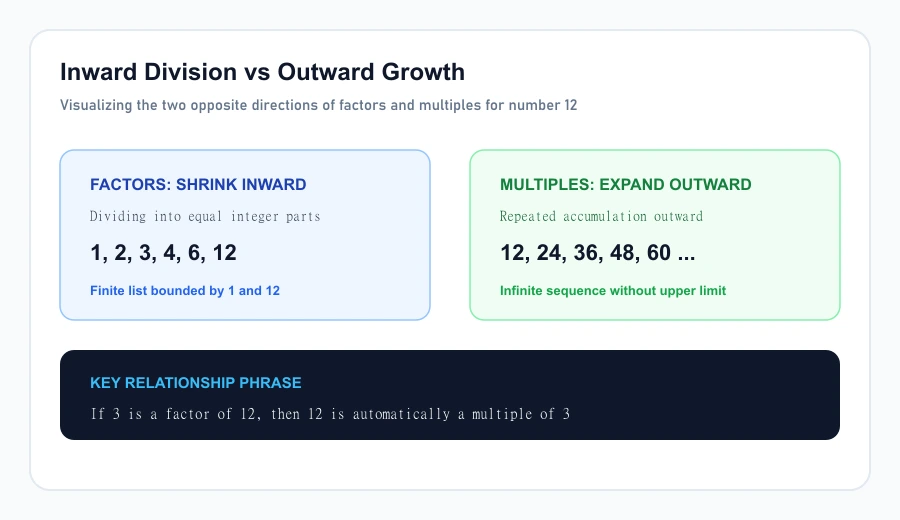
Visual concept diagram illustrating how factors divide into a number while multiples expand outward
How to Tell Whether a Number Is a Factor or Multiple
Ask which direction the relationship flows. If the number divides evenly into another, it’s a factor. If it results from multiplying, it’s a multiple. This simple test resolves most confusion.
Identify factors and multiples by checking division versus multiplication. A quick factor from division or multiple from multiplication test instantly clarifies which category any given number pair belongs to.
How Multiplication and Division Reveal the Difference
Multiplication relationship builds multiples upward without limit. Division relationship finds factors, which stay capped at the original number. This structural contrast is the cleanest way to separate the two ideas.
Every exact divisor relationship doubles as a multiple relationship viewed backward. Understanding both multiplication relationship and division relationship together builds a complete, confusion free picture of the topic.
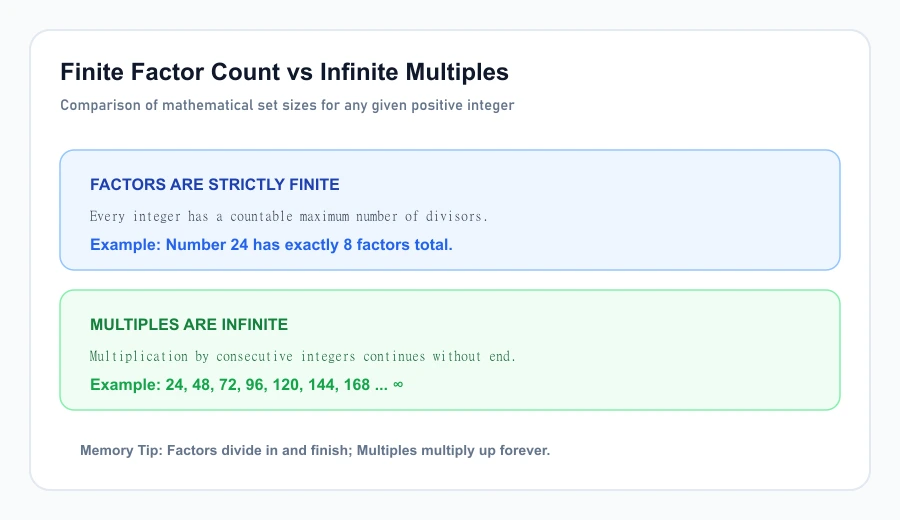
Comparison diagram showing finite sets of factors versus infinite sequences of multiples
How Factors and Multiples Work in Real Examples
Take 5 and 20. Since 20 divided by 5 equals exactly 4, 5 is a factor of 20. Since 5 times 4 equals 20, 20 is a multiple of 5.
This factor and multiple examples pairing shows both terms describing one relationship, viewed from two different multiplication directions, just like factors and divisors discussed in earlier lessons.
Why a Number Can Be a Factor of One Number but a Multiple of Another
Numbers rarely hold just one role. 12 is a multiple of 3, but also a factor of 24. This flexibility depends entirely on which two numbers you’re comparing at that moment.
This shows factor multiple relationship isn’t fixed; it’s contextual. Every integer plays both roles constantly, depending entirely on its comparison partner within any given number sequences problem.
How Factors and Multiples Behave With Prime and Composite Numbers
Prime factors have only two factors themselves, but infinite multiples just like any other number. Composite number factors behave similarly, holding limited factors alongside an unlimited multiple sequence.
This shows factor count and multiple count behave completely differently. Prime numbers and multiples still stretch infinitely, even though their factor list stays famously short and predictable.
How to Avoid Confusing Factors With Multiples in Word Problems
Word problems often hide the direction. Phrases like “divides evenly” signal factors, while “repeats every” or “in groups of” usually signal multiples. Spotting these clues prevents common mix ups quickly.
Practicing factor multiple word problems regularly builds this instinct. Soon, math factors multiples language becomes second nature, and confusing the two becomes far less likely during tests or homework.
Conclusion: Factors vs Multiples Explained Clearly
Factors divide into a number; multiples grow outward from it. Once this factor multiple relationship clicks, distinguishing factors and multiples becomes second nature for confident, accurate everyday math work.