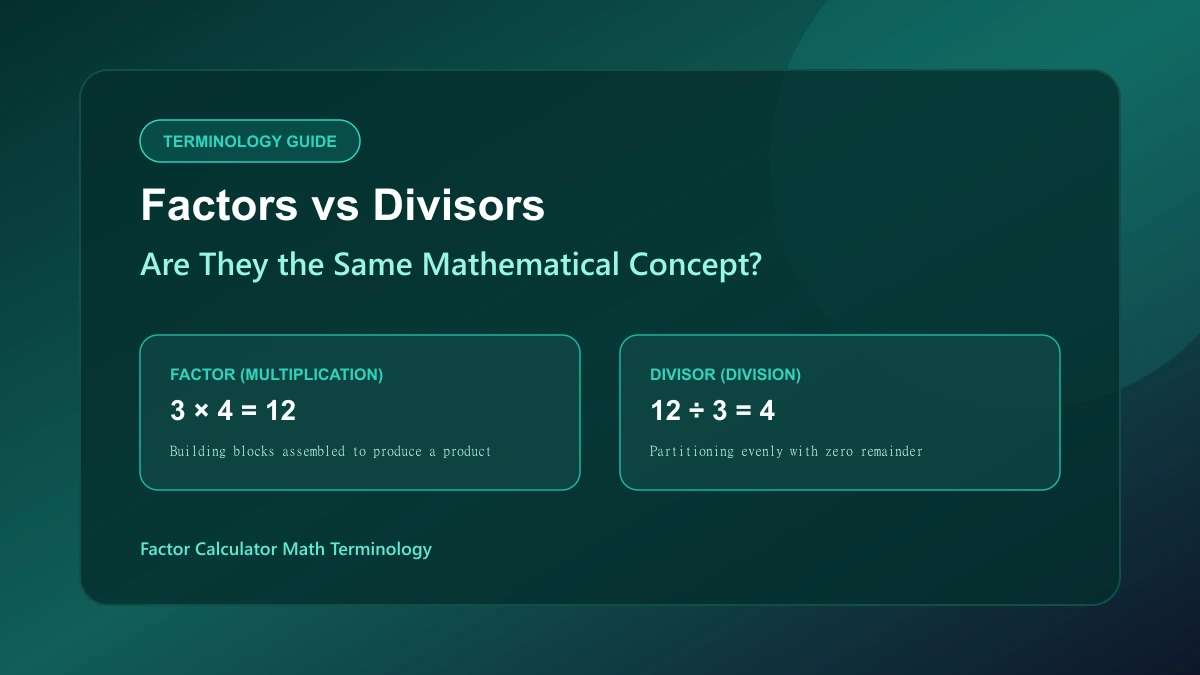
Math terms often overlap confusingly, and factors versus divisors is a classic example. This guide clears up are factors and divisors the same, showing where the terms match and subtly differ.
What Is a Factor in Mathematics?
A factor is a whole number that multiplies with another to produce a specific product. Factor definition math centers on multiplication, describing numbers that build up toward a larger result together.
Factors of an integer always divide that integer evenly too, which is exactly where the confusion with divisors begins. Still, the emphasis in “factor” leans toward multiplication first.
What Is a Divisor?
A divisor is a number that divides another evenly, with no remainder left over. Divisor definition math centers on division, describing the same relationship but viewed from the opposite mathematical direction.
Divisors of an integer produce a clean quotient with zero remainder. This division focused framing is the core difference in emphasis between divisor language and factor language.
Why Factors and Divisors Usually Describe the Same Relationship
In practice, factor vs divisor rarely matters. Both terms describe numbers that divide another number evenly. Most textbooks and teachers use them interchangeably without causing any real confusion.
| Term | Focus | Example (12) |
|---|---|---|
| Factor | Multiplication | 3 × 4 = 12 |
| Divisor | Division | 12 ÷ 3 = 4 |
Both describe 3 as related to 12 identically.
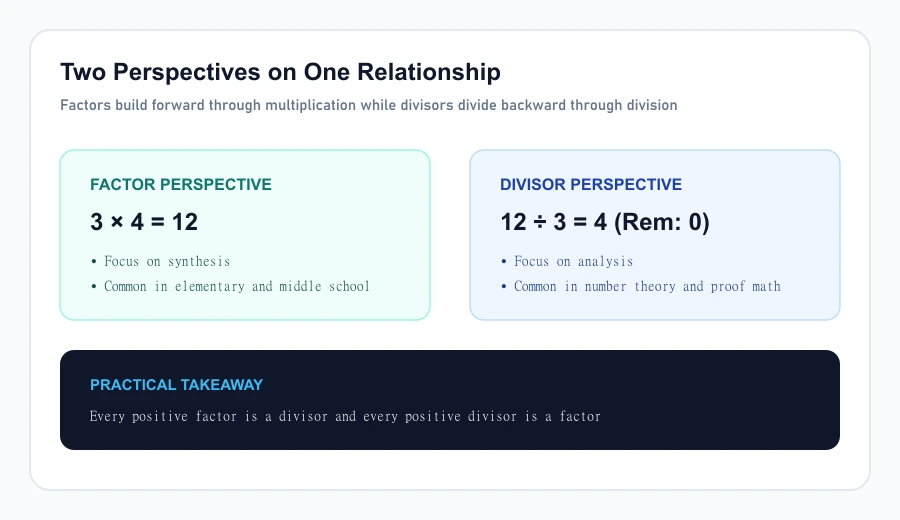
Infographic contrasting multiplication viewpoint for factors and division viewpoint for divisors
How Division Helps Identify Both Factors and Divisors
Division factors work by testing exact division. If a number divides another with zero remainder, it qualifies as both a factor and a divisor simultaneously, confirming the terms’ overlap.
This divisibility relation underlies both concepts. Whether you say factors from division or divisors from division, the underlying math test, checking for a clean quotient, stays exactly the same.
What Is the Difference Between Proper and Improper Divisors?
A proper divisor excludes the number itself, counting only smaller divisors. An improper divisor includes the number itself. This proper divisor meaning matters especially in topics like perfect numbers.
Proper factors follow the same rule, excluding the original number. Understanding proper divisor versus improper divisors helps avoid confusion when working through divisor sum or factor sum problems.
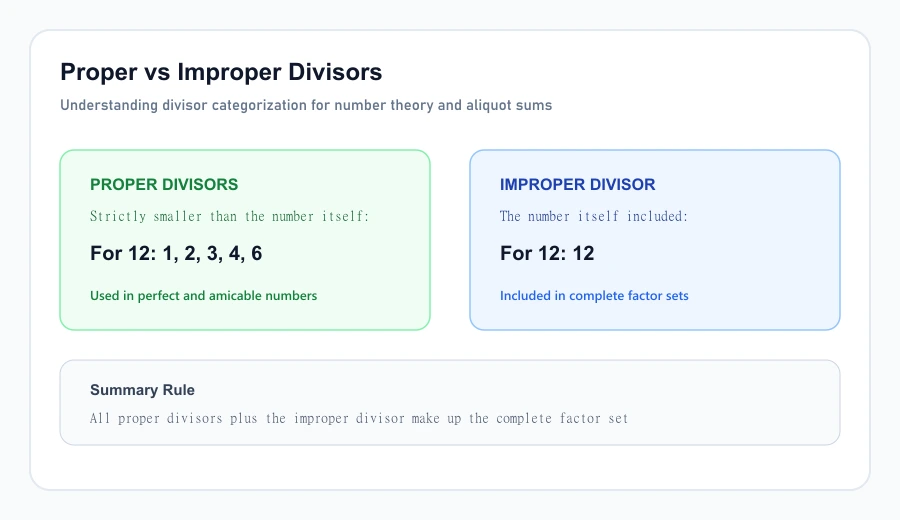
Educational chart defining the distinction between proper divisors and improper divisors
How Factors and Divisors Appear in Real Math Problems
Common factors and common divisors show up constantly in GCF work. Greatest common divisor problems use divisor language, while simplifying fractions often uses factor language instead, despite identical logic.
Recognizing this factors and divisors relationship helps across many topics. Whether a worksheet says divisor list or factor list, the expected math process stays completely unchanged either way.
How Terminology Changes Across Different Math Contexts
Higher level math courses often favor divisor language, especially in number theory and abstract algebra contexts. Elementary math tends to favor factor language for its multiplication friendly framing with younger students.
This factor terminology versus divisor terminology shift isn’t a real contradiction. It reflects teaching style and mathematical context more than any genuine difference in underlying meaning or calculation.
What Are Positive and Negative Divisors?
Technically, negative divisors exist too. Since negative 3 times negative 4 also equals 12, negative factors and negative divisors are mathematically valid, though most school level work sticks to positive divisors only.
Understanding positive and negative divisors matters more in advanced algebra. For everyday factor calculator use, positive factors remain the standard, practical, expected answer in nearly every context.
How Divisor Notation and Factor Notation Are Used
Mathematical notation sometimes uses d|n to mean “d divides n,” a compact divisor notation shorthand. Factor notation rarely uses symbols this way, preferring straightforward multiplication statements instead.
This factor notation versus divisor notation difference shows up mainly in formal proofs. For everyday factor examples and divisor examples, plain language description works perfectly well without symbols.
Conclusion: Are Factors and Divisors the Same?
In everyday math, factors and divisors describe the same relationship from two angles: multiplication versus division. Whether you use a factor finder or divisor finder, the results and logic stay identical.